


 |
 |
“At the age of three, I told my parents that I wanted to learn how to help animals,” says Frick from her Union, Mo., veterinary clinic. “I spent a lot of time in our barn back then, and cats were plentiful. They had to succumb to the role of patient while I was playing animal doctor!”
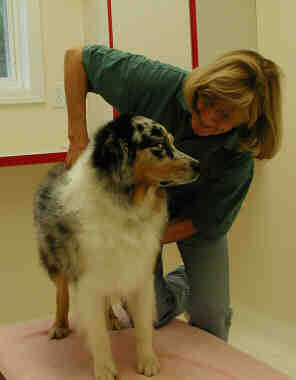
But even after Frick graduated from the University of Missouri with a degree in veterinary medicine some two decades later, her education to help animals was still far from complete. In 1997, she become certified by the American Veterinary Chiropractic Association (AVCA), and since then has been applying her chiropractic skills to the dogs and horses that make up much of her “Animal Fitness Center” veterinary practice.
Like millions of other Americans who suffer from back and neck problems, Frick readily acknowledges the benefit of chiropractic care for people. “I had been going to a chiropractor regularly since a soccer injury in 1987. So I was very familiar with human adjusting.”
She points out that just like humans, animals suffer pain and discomfort when vertebrae are damaged through injury, old-age or extreme stress. “What happens is that the joints in the spine shift out of their correct position,” says Frick.
“Chiropractors call that a subluxation. This can affect the associated soft tissue such as nerves, muscles, tendons, ligaments, cartilage surfaces, and blood vessels. That can lead to changes in the function of the body’s organs, immune system, and autonomic nervous system. By reversing the subluxation through physical manipulation, we can usually correct the problem.”
There are only 3 certified programs in the U.S. that teach chiropractic care for animals, the nearest being in Illinois. “Training requires about 200 hours,” says Frick. “Following that, there are the board exams for the AVCA certification. Even chiropractors who work with people and want to work with animals must go through the same training.”
But she cautions people about attending short, weekend “quickie” courses for the general public to learn these skills for themselves. “These are not AVCA approved, and do not teach technique or diagnosing to the degree that the skill can be applied in a scientific, educated manner.”
Frick admits it takes time for a vet to learn chiropractic skills. “You have to develop the finger sensing, motion palpation, and correct adjusting techniques to correct the subluxations. This is all foreign to vets. We can develop the skill, but it takes devotion, concentration, and a unique sense. It took me 1 1/2 years to get to the point that I felt I was right-on in my assessments.”
Today, Frick treats patients from all over the region, especially east St. Charles County, near St. Louis, and throughout Illinois. “I’m now averaging about 2,400 patients per year.”
Many of her patients are horses, which she says are particularly prone to back problems since they are often required to carry saddles and heavy riders. But it’s not just the rider and saddle that causes problems. If a horse is not properly shoed, spinal injuries can result when it is exercised or raced.
“The feet are everything to a horse, like dancers,” says Frisk. “Wrong hoof angle, long toe, short heels, and then there are a plethora of different shoes. These can change the position of every single joint, so the possibility for subluxations is immense.”
In addition to horses, dogs are regular clients too. “During the St. Louis Agility event this summer, I adjusted 43 dogs in one day. My fingers were sore for several days!” But Frick has also adjusted cats, rabbits, cows, reptiles - even an alpaca. And a couple of years ago, the Springfield, Mo., zoo called her for advice on a baby giraffe!
But Frick has not forgotten her veterinary past. She is not opposed to prescribing drugs for her patients or recommending an operation when appropriate. But in the case of spinal problems, and symptoms stemming from them, she says chiropractic care offers a more permanent and often cheaper solution. “The drugs will work fast, but if the pain is due to a subluxation in the spine or extremity, it will not abate, so the drugs become a constant necessity.”
So how does a pet owner know if his or her animal needs chiropractic care? Frick suggests looking for changes in the animal’s personality, a reluctance to move, shows pain in the legs or back, becomes sensitive to touch, or its skin crawls when being petted. “With horses, a rider can often sense an inability to take a certain lead, or to turn as well. It may become slower and develop a shorter stride.”
She also says active animals like greyhounds and horses are particularly susceptible. “The greater the amount of precision performance, the more likely an animal will need chiropractic care to maintain optimal efficiency of all joints.”
Pet owners visiting Frick’s Center for the first time will often be concerned that chiropractic adjustment may distress their pet. Although older animals can sometimes be cantankerous when adjusted, Frick says that most respond favorably to treatment.
“When I meet an animal for the first time I do not immediately move in on its space. I stand next to it, often ignoring it, then it gets curious and seeks my attention. We also play relaxing music here, so at least the owners are calmed! Dogs will pick up on that immediately.”
Through the years, Frick has learned to appreciate that animals have a sense and drive for normalcy. She says they know the adjustments are making them feel better. “Their eyes will soften, heads get lower, and sometimes they even doze. Dogs will often lick me afterwards, as if to say thank you! Horses also lick and chew.”
Even after performing thousands of adjustments, Frick still chuckles when a horse turns around to stare at her while being treated. “When I make the adjustment they will buck up into my hands, as if trying to help it along.”
Frick admits that some people still remain skeptical of applying chiropractic care to animals. “But after seeing the patient success and happiness of the owner, many are coming around!”
For more information about Dr. Frick’s Animal Fitness Center, visit www.avafrick.com.


